The Sound of Complexity

Ursula J’vlyn d’Ark
Ursula J’vlyn d’Ark is an artist and software developer based in Tiohtià:ke/Montréal, on the unceded Indigenous lands of the Kanien’kehá:ka Nation. Originally from the Deep South of the United States, they were reborn in the queer underground of Montréal and grew up in the electronic music and art scenes of their adopted home. By night they work as an audio engineer and sound artist, featured at festivals such as Piknic Électronik, Igloofest, and Mutek. By day, they work as a software researcher / backend developer and provide consultation for A/V projects. As an artist, d'Ark moves fluidly between media where her work flows through audio, video, performance, digital, and interactive modes - demonstrating that her message is beyond the medium.

The Sound of Complexity

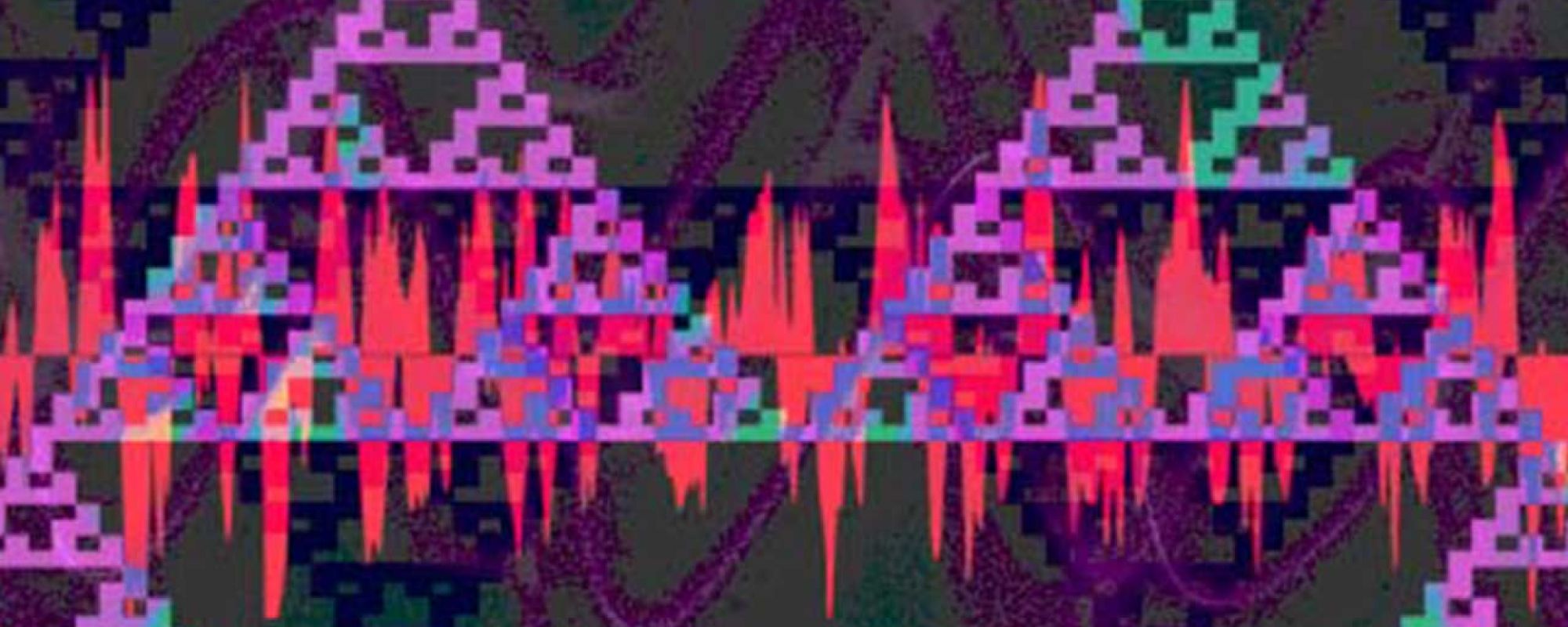
The Sound of Complexity is an ongoing research-creation project by Ursula J'vlyn d'Ark focused on the translation of complex systems into soundscapes. Complex systems are "a system in which large networks of components with no central control and simple rules of operation give rise to complex collective behavior, sophisticated information processing” and which “exhibits nontrivial emergent and self-organizing behaviours” (Melanie Mitchell, Complexity: A Guided Tour). These emergent behaviours are often described as "greater than the sum of their parts" due to the fact that there is seemingly no overall governing principle - yet, somehow, these complex systems spontaneously organize.

Classic examples of a very simple complex system are Wolfram's Cellular Automata: a set of discrete mathematical models of computation in which a growing grid of cells are governed by a simple set of rules. These cellular automata cannot "see" beyond their direct neighbour-cells - and yet, these cells governed by simple rules are able to form complex patterns. It was these cellular automata that I used for my example of a complex system in this project.

To accomplish the goal of translating these complex systems into soundscapes, I adapted a Max (Cylcing '74) patch that interpreted images of cellular automata and transformed them into MIDI notes. These MIDI notes were then plugged into a DAW (Ableton Live) and mapped to different keys, octaves, and instruments within. This process required a mixture of intuition and artistic interpretation - as there was no clear "right" way to do these mappings. Instead, I focused on insuring the output audio sounded congruous with the complex system that was input. After some trial and error, the soundscapes of cellular automata emerged. Have a listen and see if you can hear the patterns of the complex system within!

External Links

Documentation

All media are the property of the artists, reproduction and distribution is prohibited.

2021